精选观点 & Webinar

We are delighted to invite Edmund Ng, Founder & CIO of Eastfort Asset Management to share with us the nuances of investing in the China bond markets, and the tailwinds, headwinds and sweet spots for international investors. Edmund brings very deep understand of the China bond markets as a veteran practitioner, and was the Head of the Direct Investment Division of Hong Kong Monetary Authority (HKMA), which under his leadership started to diversify part of its large reserves into other asset classes including CNY bonds. [WATCH NOW]
Jun 16, 2021

The inflation threat is now clear and present. And while equities may tolerate rising US inflation for a while longer, the Developed Market bond markets are highly vulnerable.
May 26, 2021

China’s tough new regulations on its tech giants will result in competitive gains for consumers, level the playing field for small and medium enterprises, and generate productivity gains for the economy.
May 24, 2021

KOSPI and TWSE outperformed the S&P 500 over 6 months and 12 months. South Korea’s KOSPI and Taiwan’s TWSE indices have outperformed the S&P 500 over the past 6 months and 12 months. However, on a year-to-date basis, the S&P 500 has done better than the KOSPI but continues to lag the TWSE by a long way.
May 06, 2021

It is inevitable that the traditional 60/40 asset allocation split between bond and equity no longer work well as the fixed income portion is not generating sufficient stable income.
May 06, 2021

As our Senior Advisor Sayboon Lim stated in the article “Gimme shelter” that it is essential for investors to have China sovereign bonds in their asset allocation, it would be timely for us to introduce the newly launched Premia China Treasury and Policy Bank Bond Long Duration ETF for your consideration.
Apr 28, 2021

Index provider FTSE Russell will add Chinese Government Bonds (CGBs) to the FTSE World Government Bond Index (WGBI) over three years from the end of October – a move that is expected to draw billions of Dollars of new portfolio inflows. Already, there has been a sharp increase in foreign inflows into RMB bonds over the past 12 months, accelerating soon after the start of the pandemic. In this 2-part series, our Senior Advisor Say Boon Lim highlights the drivers for new demand for CGBs and the reasons to own them.
Apr 22, 2021

A popular media narrative for the recent correction in Chinese equities was that it was caused by tightening of financial conditions in China.
Mar 31, 2021
Being the first-in-first-out, China has been the first one to reopen and recover from the pandemic last year. While the recovery has been uneven and is still underway going into 2021, in Q4 we observed sector and factor rotation started to kick in, with Value and LowRisk being the best performers toward the year end.
Mar 23, 2021
Economic policy settings between the United States and China – which have been diverging since the onset of the COVID-19 pandemic – are now on stark display as a result of the recent outcomes of the annual plenary session of the National People’s Congress.
Mar 18, 2021
Premia 图说

吴伟锋
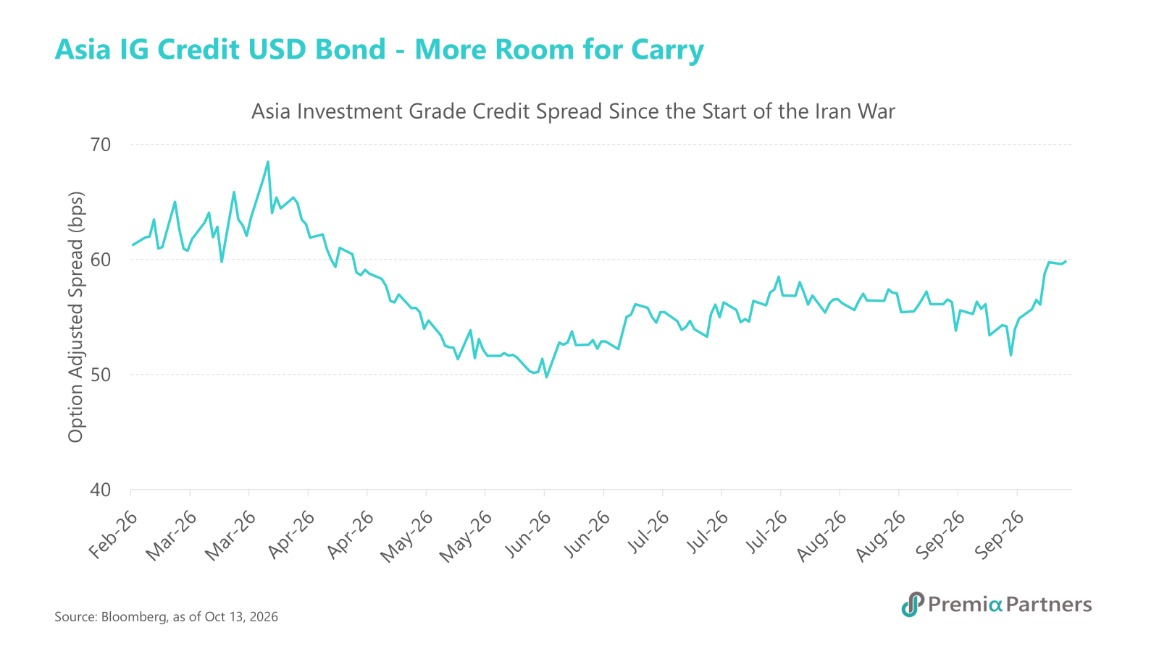
Year-to-date Premia J.P. Morgan Asia Credit Investment Grade USD Bond ETF (Premia Asia IG ETF) has outperformed longer duration peers. Even as US Treasuries yield widened to their highest yields in over two decades, the Asia IG ETF has proven relatively resilient. Across assets classes, some investors now see US Treasuries as better value than US equities and started rotating from US risk asset to duration – yet Asia IG still offers a yield pickup over US Treasury - making it even more attractive. Asian credit spreads widened modestly in recent weeks on concern about Indonesia and Philippines, and have begun to retrace as those worries ease. In our view, the current spread level offers a better window to add to Asia investment grade (IG) credit. Indonesia has been viewed as the region's main fiscal pressure point, with concerns over state spending and the credibility of the 3% of GDP deficit cap weighing on Asian spreads more broadly. The government has since begun to rein in expenditure. While the announced measures look modest, but markets read them as a sign of discipline : Indonesia's 5-year CDS has eased from a recent high of ~96bps to ~91bps as of 12 October, pointing to stabilisation. Meanwhile, despite the near-term pull back in the US 10-year yield, large US deficits point to heavier issuance, so holding long duration outright carries meaningful risk. Shorter-duration IG credit offers a better balance. The Premia J.P. Morgan Asia Credit Investment Grade USD Bond ETF (3411/9411 HK) offers a ~4.3-year duration and a ~5.5% average yield to maturity, with an average A rating and around 10% in floating-rate notes. That lets investors earn carry and stay invested with moderate rate exposure. In a market still arguing over where yields settle, The Premia Asia IG ETF offers a way to be paid while the debate plays out — a better balance between rate bets and carry, and a more sensible place to “keep calm and carry on”.
Oct 14, 2026