精選觀點 & Webinar

Yes, possibly. The different approaches taken by the US and China towards managing COVID-19 has likely set the stage for a widening of the growth differential between the two countries. Immediately, the earlier reopening of the Chinese economy means China’s GDP will still show a bit of growth this year. This compares to the controversial, tentative easing of restrictions in the US, only in May. Even if the US gradually normalizes from here, its GDP for will end 2020 with a big hole, which will take three to four years to fill. If China maintains its productivity growth, it should be able to manage a long-term average GDP growth rate of around 5.8% a year. Meanwhile, long-term US GDP growth from 2022 onwards could ease to 1.5% on lower investment/lower productivity growth. Taking into account IMF projected growth rates for 2020 and 2021, China could overtake the US in Dollar terms by 2029.
May 13, 2020
We previously highlighted the gaming industry just after the coronavirus outbreak in Account of an atypical, tech-enabled CNY holiday. With the COVID-19 pandemic raging on globally and people spend more time at home social distancing, the gaming industry has shown greater potential of booming opportunities. The large demographic base of tech-savvy and mobile-first youths born in the digital era provided a strong head start for China, especially in eSports.
May 11, 2020

即使是不玩電動的人,也肯定會知道最近在全球爆紅的switch遊戲動物森友會。事實上,電玩產業的規模非常巨大,市場規模已經超過10億美元,受疫情影響,大家持續保持社交距離且居家時間拉長,電玩也成為大家排憂解悶的重要途徑。截止2019年底,全球遊戲市場收入已經超過1500億美元,而其中45%來自智慧型手機和平板電腦上的手遊。在電玩產業中, 電競在過去十年已經發展成一個重要的行業。全球電競收入估計在今年會超過10億美元,而中國目前佔其中的20%。本期webinar,我們將與大家分享「社交距離」下的虛擬世界:中國的遊戲、電競和直播產業。
May 08, 2020
The COVID-19 pandemic has slowed down productivity and daily lives, stagnated the global supply chain, and affected financial market returns across almost all asset classes. In the first quarter of 2020, all markets around the world reported negative returns with varying degrees. While it seems that all is going the same direction, especially in the equities’ world, the fundamental risk factors were not. Among the fundamental factors we employ for China A shares, some has performed better than others amidst the market drawdown.
Apr 28, 2020
Premia CSI Caixin China New Economy ETF performed well and went up by 3% in a down market. In this article, we would like to share with you the reasons behind the strong performance and the comparison of this strategy with the other mainstream indexes that investors usually track in respect to performance attribution, sector allocation, niche thematic exposure and top drivers.
Apr 24, 2020
疫情衝擊下,中國推出40萬億人民幣的「新基建」計劃振興當前經濟,「#新基建」因而頻頻炒上熱搜榜,點燃市場廣泛關注及業界討論。「新基建」到底為何?「新基建」概念股又該從何下手?
Apr 17, 2020
The market performance of gold in the midst of the COVID-19 crisis has left its fans a little puzzled. From a peak of USD 1703 on 9 March, it retreated to USD 1451 on 16 March - a 15% decline. Should one hold gold now, or rather park in cash tools? Our senior advisor Say Boon Lim demystifies in this piece.
Apr 14, 2020
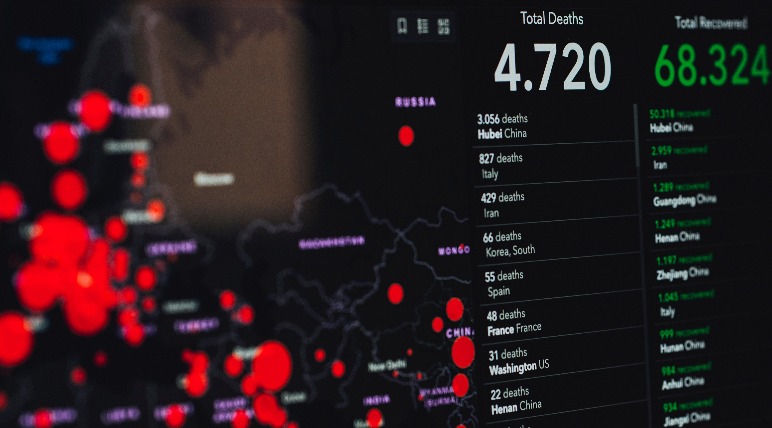
As global asset prices have slumped on the back of the COVID-19 outbreak, concerns have arisen from supply chain disruptions to about global recession and a liquidity crisis. In this webinar, David Lai and Larry Kwok would discuss the lessons learned from the GFC, share our observations of some pandemic-led trends and implications, and suggest a few related investment ideas.
Apr 13, 2020
The COVID-19 outbreak has led to a worldwide pandemic, a global slowdown, arguably a recession and hopefully not a depression. Business activities globally have been halted due to the outbreak and demand has been shrinking significantly as well. Apart from some of the Asian countries including China, we have yet seen an inflection point of the case curves in most countries. In this article, we’d like to share some notable leading Chinese players in the space that have been working hard to fight against the virus for the domestic and global community.
Apr 03, 2020
The virous outbreak becomes one of the largest threats to the global economy and financial markets in decades. Will China, the one which has been suffered from the pandemic first, be able to bounce back first and lead the recovery worldwide like the Global Financial Crisis back in 2008? The latest call in new infrastructure investment maybe the key.
Mar 20, 2020
Premia 圖說

吳偉鋒
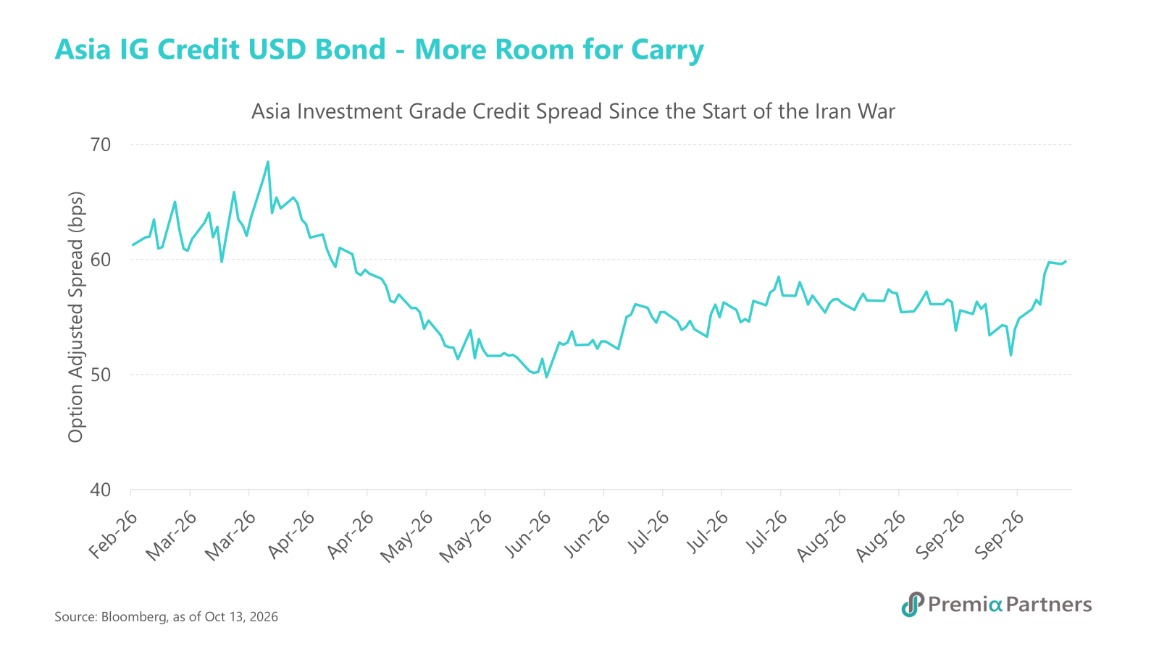
Year-to-date Premia J.P. Morgan Asia Credit Investment Grade USD Bond ETF (Premia Asia IG ETF) has outperformed longer duration peers. Even as US Treasuries yield widened to their highest yields in over two decades, the Asia IG ETF has proven relatively resilient. Across assets classes, some investors now see US Treasuries as better value than US equities and started rotating from US risk asset to duration – yet Asia IG still offers a yield pickup over US Treasury - making it even more attractive. Asian credit spreads widened modestly in recent weeks on concern about Indonesia and Philippines, and have begun to retrace as those worries ease. In our view, the current spread level offers a better window to add to Asia investment grade (IG) credit. Indonesia has been viewed as the region's main fiscal pressure point, with concerns over state spending and the credibility of the 3% of GDP deficit cap weighing on Asian spreads more broadly. The government has since begun to rein in expenditure. While the announced measures look modest, but markets read them as a sign of discipline : Indonesia's 5-year CDS has eased from a recent high of ~96bps to ~91bps as of 12 October, pointing to stabilisation. Meanwhile, despite the near-term pull back in the US 10-year yield, large US deficits point to heavier issuance, so holding long duration outright carries meaningful risk. Shorter-duration IG credit offers a better balance. The Premia J.P. Morgan Asia Credit Investment Grade USD Bond ETF (3411/9411 HK) offers a ~4.3-year duration and a ~5.5% average yield to maturity, with an average A rating and around 10% in floating-rate notes. That lets investors earn carry and stay invested with moderate rate exposure. In a market still arguing over where yields settle, The Premia Asia IG ETF offers a way to be paid while the debate plays out — a better balance between rate bets and carry, and a more sensible place to “keep calm and carry on”.
Oct 14, 2026