精選觀點 & Webinar

Last December China launched a major national venture capital fund, a national guidance fund and three large regional funds (Beijing-Tianjin-Hebei, Yangtze River Delta, Greater Bay Area), all designed to channel billions of development capital into "hard technology" sectors like semiconductors, AI, and biomedicine to fast track its trajectory to overcome the current choke points and achieve technology independence amid persistent geopolitical tension. Meanwhile, Bloomberg reported that China is also considering a US$70 billion package of incentives to boost its semiconductor industry. These are only the latest in a string of boosters: China had already announced numerous measures over the past two years, estimated to value almost US$100billion, to lift capabilities in its chip sector. In this article, we reviewed China's ongoing efforts in the global chip race, and how under rapid acceleration in domestic substitution across cutting-edge logic chips, memory foundries, and AI models, our China New Economy (3173 / 9173 HK) and China STAR50 (3151 / 9151 / 83151 HK) strategies are uniquely positioned to capture these structural opportunities.
Apr 08, 2026

Despite last year’s pronounced rally in onshore Chinese stocks, the fourth quarter saw strong rotation from growth plays to a value theme, leading to divergence in the Bedrock and New Economy strategies over the final few months of the year. That said, we note all three of the Premia China ETFs showed marked outperformance over broad market, as investors continued to pivot to hardcore technology and strategic new economy sectors notwithstanding profit taking and risk-off sentiments towards the year end. In fact, under strong tailwinds such as domestic substitution policies, China’s economic engine is being reconfigured as many of these emerging leaders started to show fast tracked earnings growth and profitability. With this background, CSI Caixin Rayliant New Economic Engine Index (tracked by Premia China New Economy ETF - 3173 / 9173 HK ETFs) outperformed CSI300 solidly with total gain of 23.9% for full-year 2025, while China STAR50 index (tracked by Premia STAR50 ETF - 3151 / 9151 / 83151 HK ETFs) delivered even stronger full-year return of 36.5% notwithstanding the end of year profit taking. Meanwhile, as Low Risk, Value, Quality factors advanced in Q4, as a defensive strategy in risk off environment CSI Caixin Rayliant Bedrock Economy Index (tracked by Premia China Bedrock Economy ETF - 2803 / 9803 HK ETFs) outperformed the broader market with a gain of 4.9% for the quarter, bringing its full-year return to 12.6%. In this article, Dr. Phillip Wool, Global Head of Research of Rayliant Global Advisors, discussed the macro and factor-level influences, and provided a concise summary of contributors to China A share performance in Q4 2025 and possibly into 2026 as we kick start the first year of the 15th Five Year Plan.
Mar 16, 2026

With many of the global leading high tech manufacturing players, the Taiwan stock market sits at the confluence of the global tech super cycle, robust earnings growth and modest valuations, and is home to many global leading Asian technology players. The fundamental tailwinds that drove the Taiwanese stock market’s outperformance from 4Q25 are likely to continue carrying the rally in 2026. Indeed, the Taiwan market appears to be in the early stages of its outperformance cycle. In this article, our Senior Advisor Say Boon Lim explores why in addition to TSMC, the blue chip cohort from Taiwan offers global investors a unique diversification opportunity, providing exposure to technology super cycle beyond US big tech names, complemented by its attractive valuations and low correlations with other major asset classes.
Feb 02, 2026

Analysts including JP Morgan, Goldman Sachs, Morgan Stanley, HSBC, and Standard Chartered are generally bullish on Emerging Markets (EM) for 2026, citing dollar weakness, AI growth, and affordable valuations. Within EM, EM ASEAN is an under-appreciated sweet spot that blends value, yield and structural upsides. In this article, our Senior Advisor Say Boon Lim discusses how the region transitions towards more domestically-driven growth, with macro tailwinds from significant foreign direct investments, public infrastructure spending, and robust exports fuelled by AI demand and global supply chain dynamics.
Jan 19, 2026

As markets enter 2026, the need for diversification has gained an urgency not seen since possibly at the peak of the Nasdaq Bubble in year 2000. Both US stocks and corporate credits are priced for perfection in an economy that has been held up by stretched fiscal and monetary stimulus. The sales pitch of “American exceptionalism” may be wearing thin. US Big Tech is overpriced and may have overinvested in AI. Meanwhile, the labour and consumer markets are weakening even while inflation remains stubborn. The long-end of the Treasury yield curve has started ignoring rate cuts – a sign of concern about the sustainability of US government debt. In this article, our Senior Advisor Say Boon Lim discusses the urgency of diversification away from US-overpriced assets, while China and emerging ASEAN markets present compelling complementary attributes for diversified multi-asset portfolios.
Jan 13, 2026

China approaches 2026 on a firmer economic and market footing, supported by clearer policy direction and a maturing innovation ecosystem. While growth may ease slightly from recent levels, structural themes—ranging from advanced manufacturing upgrades to measures addressing excess capacity—are set to shape the early phase of the 15th Five-Year Plan. Domestic investors are gradually shifting from deposits toward higher-return financial assets, adding resilience to onshore markets. In fixed income, moderating yields and strengthening demand for RMB-denominated assets create a more constructive backdrop for China government bonds. In this article, our Partner & Co-CIO David Lai discusses how these developments foster a more stable and attractive investment landscape, offering compelling opportunities to express China exposure across both equities and fixed income.
Jan 13, 2026

AI was the common theme for growth across markets last year. S&P500 and Nasdaq delivered +17% and 21% respectively in USD terms for FY2025, while China broad market (CSI300) rallied 21%, and China tech outperformed with +46%, Asia tech was up +45% and Taiwan stock market gained +40%. Going into 2026, few would dispute drivers for stock market performance would continue to be innovation-led opportunities. In this article, we discuss tailwinds from the hardcore tech especially AI infrastructure, semiconductor, robotics, and biotechnology, where technological breakthroughs, accelerated commercialization and improved earnings growth and profitability support further re-rating actions ahead. This is where our Premia China STAR50 ETF and Premia China New Economy ETF focus on, and would serve as efficient and optimized vehicles to provide direct access to the leading beneficiaries that are poised to define China's economic trajectory in 2026.
Jan 13, 2026

Following a historic breakout in 2025, the Premia Vietnam ETF rallied a stunning 73% (total return in USD NAV) in 2025, while the broad market also rallied 39%. The market is now transitioning from recovery in sentiment to a phase of progressive policy execution, including the "Doi Moi 2.0" reforms (Resolution 68). These reforms offer unprecedented policy support for the private sector. And the mandate to nurture 20 globally competitive large private firms provide strong cases for revaluation opportunities for large cap leaders. In this article, we will explore why Vietnam remains a compelling market in 2026 amidst imminent FTSE Emerging Market upgrade. Our Premia Vietnam ETF—with its focus on private sector champions and Small-Mid caps—is distinctively positioned to capture the specific beneficiaries of these structural shifts.
Jan 13, 2026

The Fed shifted from hiking to easing as it appeared to tolerate 3% inflation as the new target and prioritized labour market conditions. The 10-year Treasury yield remained above 4% amid concerns over deteriorating US fiscal health and elevated inflation. Meanwhile, markets grew increasingly alert to vulnerabilities in US private credit, with rapid growth in AI-related investments and high margin debt cited as potential pressure points. Meanwhile, Asia’s USD credit market closed out the year on a high note, with tight spreads and strong returns driven by solid fundamentals and technicals, while Saudi government sukuk also delivered modest gains last year. In this article, we discuss how Asia ex-Japan investment grade bonds and Saudi government sukuk continue to stand out as compelling alternatives, as the trend toward diversifying away from the US is likely to persist in 2026.
Jan 13, 2026

The risk profiles of Emerging Market (EM) investment grade (IG) vs their developed market (DM) peers are converging. In fact, amidst spending/borrowing excesses in the DM, rising long-term government bond yields, and recent cyclical lows in US corporate credit spreads, volatility for DM bonds has risen substantially since 2020, prompting the expression the “EM’ification of DM debt”. Meanwhile EM IG bonds have been relatively stable, and the search by asset allocators for alternatives to DM bonds will likely continue the pivot to EM IG bonds. Beneath the surface of the short-term volatilities and possibly a longer-term repricing of multiple assets, Asian IG bonds and Saudi government sukuks may just be the sweet spots for attractive, uncorrelated and resilient returns regardless which side one is at on the debasement debate. In this article, our Senior Advisor Say Boon Lim discusses how the asset allocators are increasingly turning to EM IG bonds as compelling alternatives to DM bonds, for which our Premia JP Morgan Asia Credit Investment Grade USD Bond ETF (3411/9411 HK) and Premia BOCHK Saudi Arabia Government Sukuk ETF (3478/ 9478 HK) would be useful allocation tools in this pivot.
Nov 10, 2025
Premia 圖說

吳偉鋒
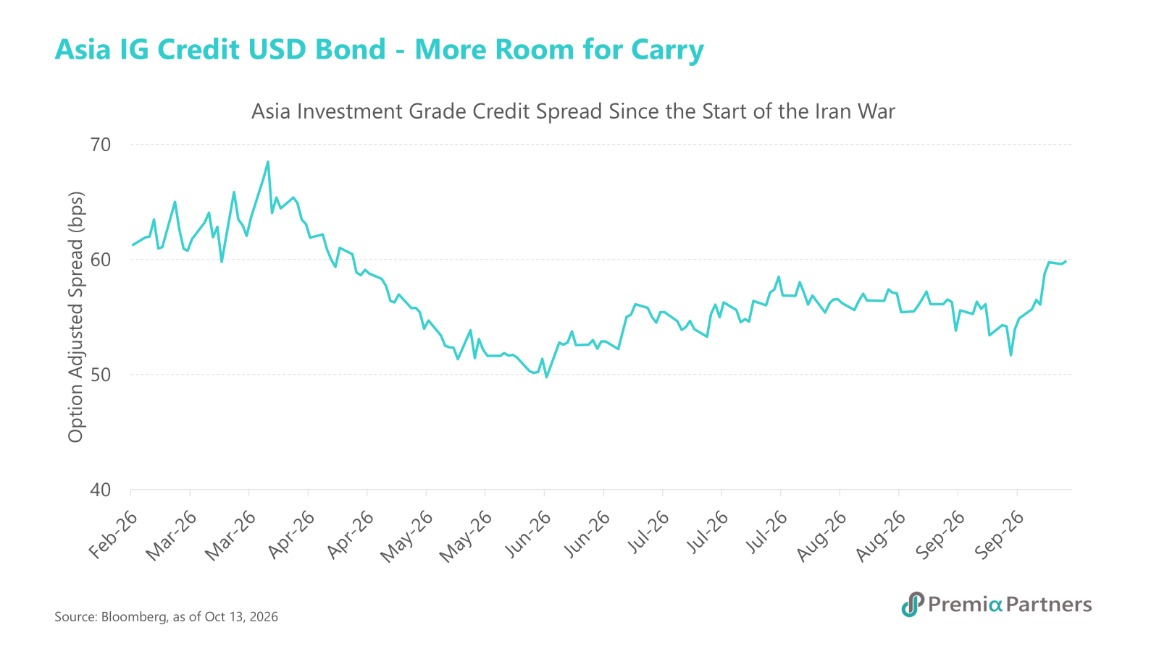
Year-to-date Premia J.P. Morgan Asia Credit Investment Grade USD Bond ETF (Premia Asia IG ETF) has outperformed longer duration peers. Even as US Treasuries yield widened to their highest yields in over two decades, the Asia IG ETF has proven relatively resilient. Across assets classes, some investors now see US Treasuries as better value than US equities and started rotating from US risk asset to duration – yet Asia IG still offers a yield pickup over US Treasury - making it even more attractive. Asian credit spreads widened modestly in recent weeks on concern about Indonesia and Philippines, and have begun to retrace as those worries ease. In our view, the current spread level offers a better window to add to Asia investment grade (IG) credit. Indonesia has been viewed as the region's main fiscal pressure point, with concerns over state spending and the credibility of the 3% of GDP deficit cap weighing on Asian spreads more broadly. The government has since begun to rein in expenditure. While the announced measures look modest, but markets read them as a sign of discipline : Indonesia's 5-year CDS has eased from a recent high of ~96bps to ~91bps as of 12 October, pointing to stabilisation. Meanwhile, despite the near-term pull back in the US 10-year yield, large US deficits point to heavier issuance, so holding long duration outright carries meaningful risk. Shorter-duration IG credit offers a better balance. The Premia J.P. Morgan Asia Credit Investment Grade USD Bond ETF (3411/9411 HK) offers a ~4.3-year duration and a ~5.5% average yield to maturity, with an average A rating and around 10% in floating-rate notes. That lets investors earn carry and stay invested with moderate rate exposure. In a market still arguing over where yields settle, The Premia Asia IG ETF offers a way to be paid while the debate plays out — a better balance between rate bets and carry, and a more sensible place to “keep calm and carry on”.
Oct 14, 2026