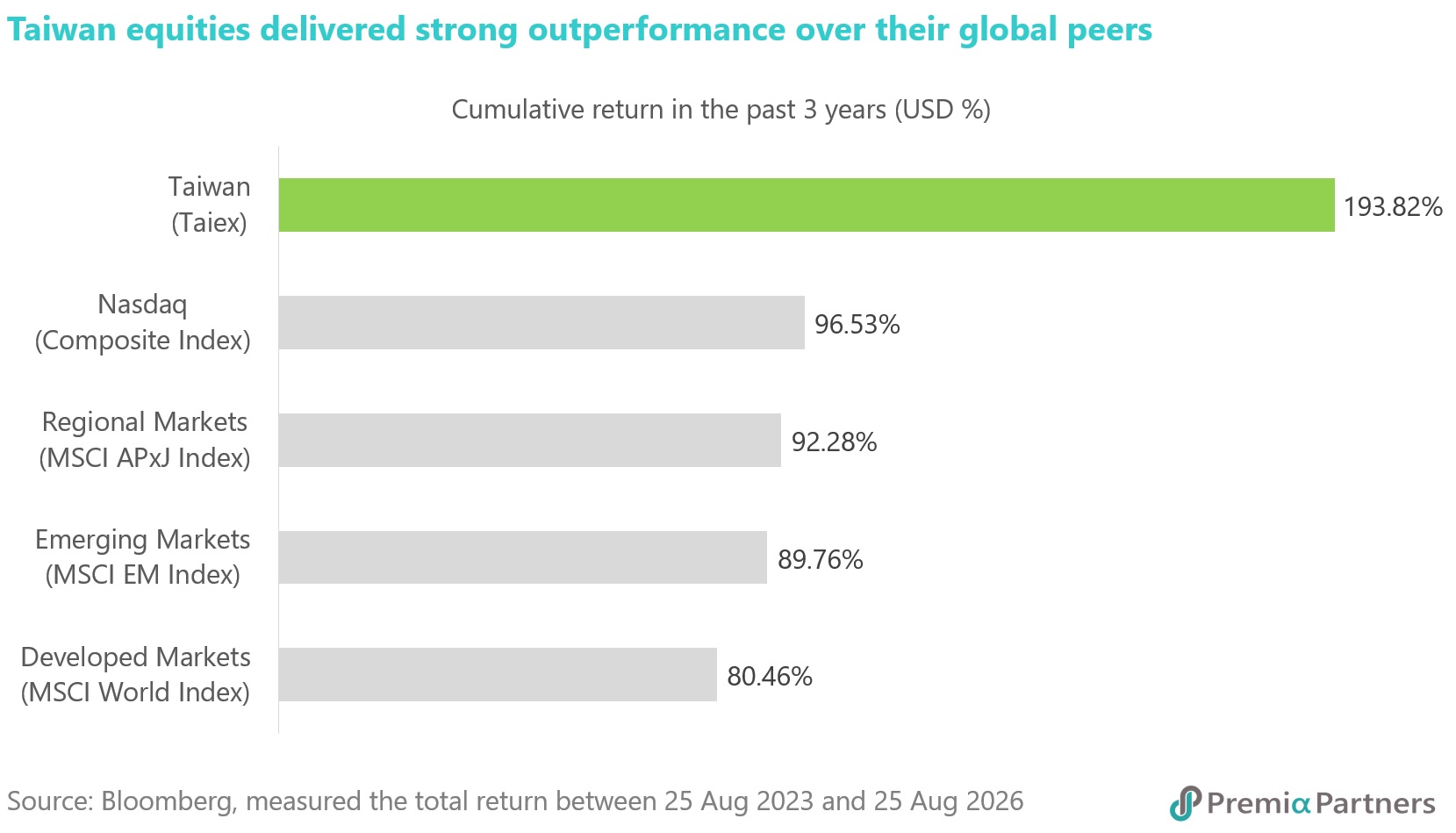
Taiwan equities have been on an exceptional run, delivering a total return of over 193.82% in the past three years and comfortably outperforming developed markets, emerging markets, regional equities and even Nasdaq. Yet despite this strong performance, Taiwan remains surprisingly under-owned by international investors. Goldman Sachs estimates that global funds, emerging market funds and regional funds are underweight Taiwan by 225bps, 431bps and 529bps respectively.
This disconnect is becoming increasingly difficult to ignore. Taiwan now represents 26.63% of the MSCI Emerging Markets Index, ahead of China at 21.38%, South Korea at 20.33% and India at 11.66% as of the end of July. Taiwan has become too important for global investors to overlook, but many portfolios still appear to be positioned as if it were a much smaller part of the emerging market opportunity.
Persistent strong performance backed by robust fundamentals
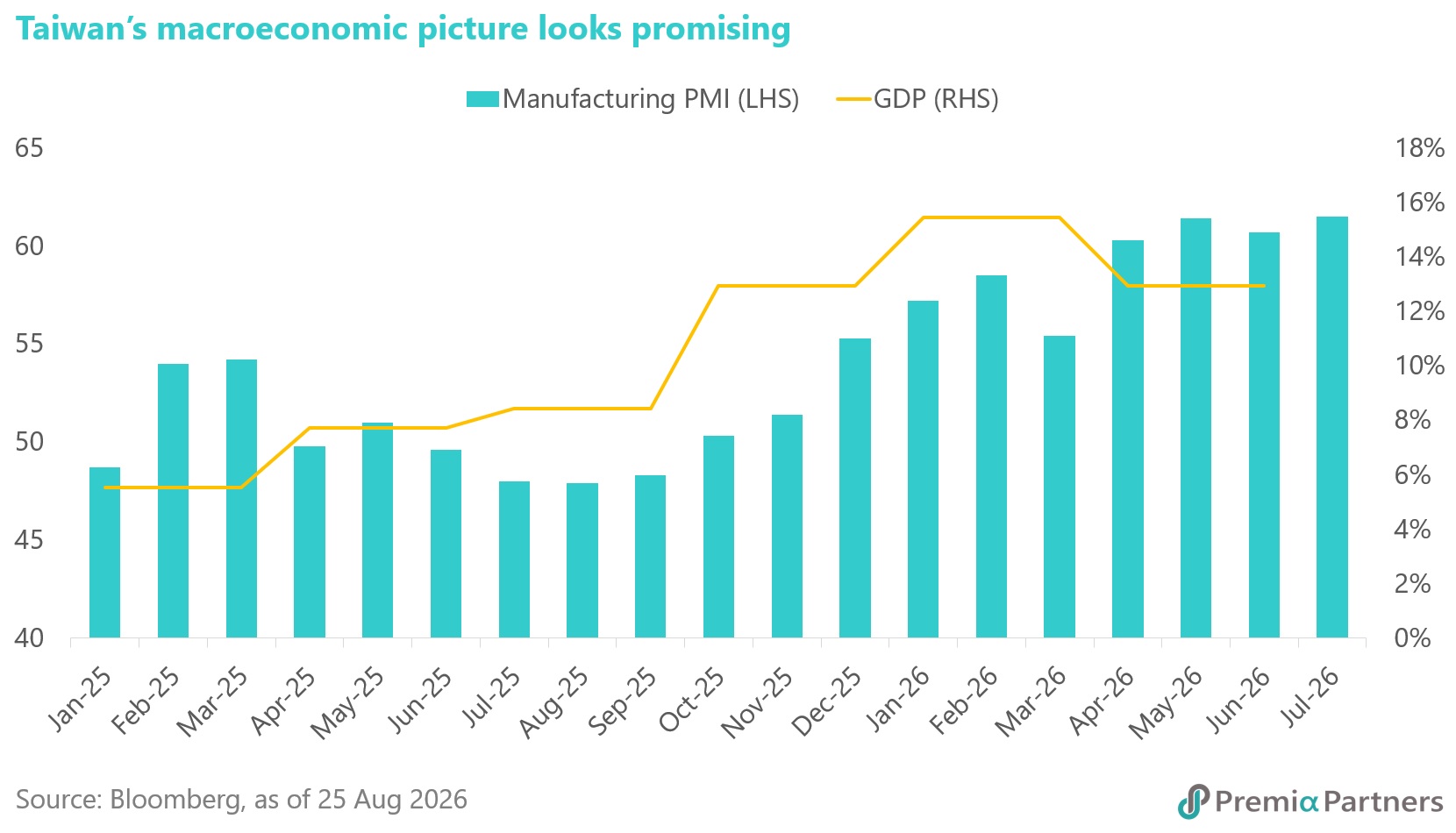
The performance speaks for itself. But the more important question is whether the fundamentals can support it. We believe they can. Taiwan’s macroeconomic picture has strengthened sharply this year. Earlier this month, Taiwan’s statistics agency raised its 2026 GDP growth forecast to 11.05%, up from 9.64% previously. If realized, this would mark the fastest annual growth since 1987.
The upgrade is largely being driven by the same force that has been reshaping global technology investment: artificial intelligence. Taiwan's exports are now expected to grow 41.07% in 2026, with integrated circuits leading the way. Semiconductor exports reached a record US$26.30 billion in July, up 52.3%, while electronic components rose 50.5% to US$27.73 billion. Information, communications and audio-video products, which include the AI servers, networking equipment and other data-center hardware, contributed another US$31.37 billion, up 29.5%. Together, the two categories accounted for 78.5% of Taiwan’s total exports in July. This is more than a cyclical recovery in exports. It reflects Taiwan’s increasingly central role in the global build-out of AI infrastructure.
The domestic data are pointing in the same direction. Manufacturing PMI rose to 61.5 in July, while the electronic and optical products sub-index climbed to 65.5. Strong AI-related demand is also prompting Taiwanese companies to increase capital expenditure, leading the government to raise its private investment growth forecast to 11.58%.
Inflation, at an expected 2.07%, remains manageable and only marginally above the central bank’s 2% target. More importantly for equity investors, earnings expectations have been rising rapidly. Taiwanese companies are now expected to deliver earnings growth of 55.37% in 2026 and another 28.63% in 2027.
Despite these strong growth expectations, valuations remain relatively reasonable. Taiwan equities are trading at 20.29x forward earnings for 2026 and 15.66x for 2027, compared with 28.59x and 22.29x respectively for Nasdaq.
In short, Taiwan is not simply enjoying strong share-price momentum. The rally is supported by a combination of economic growth, export strength, earnings upgrades and still-manageable valuations.
Taiwan’s “Silicon Shield” is challenging for others to replicate
Taiwan has spent decades building one of the world’s most sophisticated technology manufacturing ecosystems, with leading positions across semiconductor manufacturing, advanced packaging, substrates, components, power management, networking and system assembly. It controls over 90% of the world's advanced semiconductor manufacturing and virtually 100% of the ultra-high-end foundry capacity required for cutting-edge AI accelerators. While countries like the US, China, and other major economies are planning to invest heavily in domestic chipmaking capabilities, this density is difficult to replicate and gives Taiwan a unique position in the physical infrastructure behind the AI revolution.
At the center of this value chain is Taiwan Semiconductor Manufacturing Company (TSMC), whose leadership in advanced foundry technology has become increasingly important as AI accelerators move to more advanced process nodes, such as 2nm. TSMC is the only foundry globally capable of mass-producing these ultra-advanced chips with commercially viable yields that competitors like Intel or Samsung have spent years and billions failing to match. Advanced packaging is another critical part of the equation. As AI chips become increasingly powerful, connecting high-performance processors with high-bandwidth memory has become just as important as transistor density. TSMC’s CoWoS advanced packaging technology has therefore become a key bottleneck.
The strength of demand is already visible in TSMC’s numbers. Second-quarter 2026 revenue reached US$40.2 billion, up 33.7% year-on-year, while the company raised its full-year growth guidance to above 40%. Third-quarter revenue guidance of US$44.6 billion to US$45.8 billion implies approximately 37% year-on-year growth at the midpoint. TSMC also increased its 2026 capital expenditure guidance to US$60 billion–64 billion, with much of the additional investment directed towards meeting AI-related demand.
It is easy to view TSMC as the natural proxy for Taiwan’s AI opportunity. But the investment opportunity extends well beyond the foundry leader.
TSMC is the anchor, but it is far from the whole story
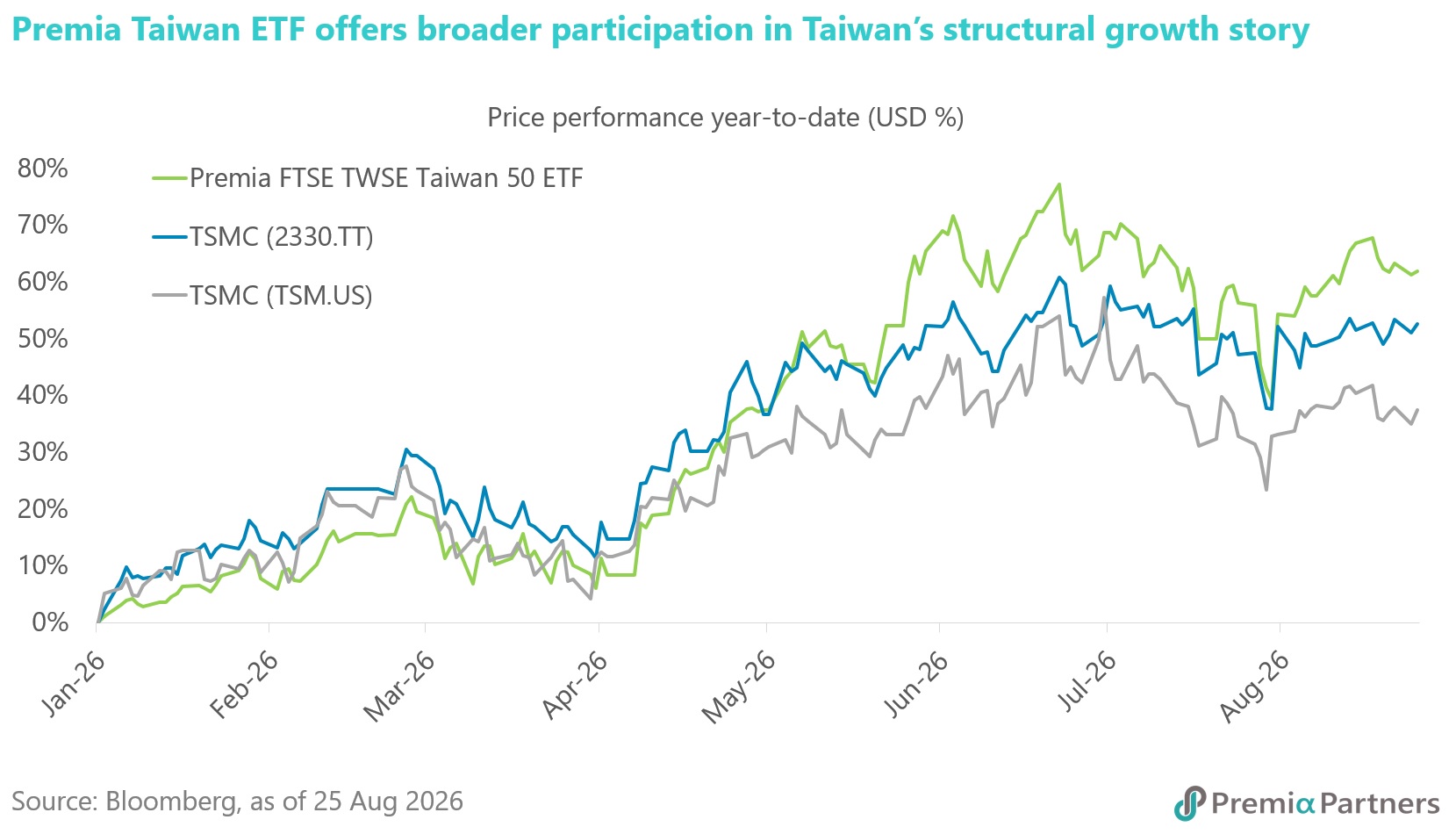
As of 25 August 2026, TSMC’s Taiwan-listed shares had delivered a total return of 53.49% in US dollar terms. Over the same period, the Premia FTSE TWSE Taiwan 50 ETF outperformed with 64.16% return. In fact, it is not even among the best performing in our 50-name cohort. The difference is meaningful. TSMC is an exceptional company, but it is also one of the world’s most widely owned and closely followed technology stocks. Meanwhile, many of the companies further down the AI supply chain are benefitting from the rapid expansion in AI infrastructure spending, often from a lower starting base and across a broader range of applications.
For investors who gain Taiwan exposure through the US-listed TSMC ADR purely for convenience, the outcome has been even less compelling. The ADR gained 38.04% over the same period, significantly behind both the Taiwan-listed shares and the broader Taiwan 50 ETF.
The lesson is not that TSMC is a poor investment. Quite the opposite: it remains a high-conviction anchor for Taiwan’s technology story. The lesson is that TSMC alone is not the same thing as Taiwan’s AI opportunity.
An AI server is not just a processor. Once silicon leaves the foundry, it becomes part of a much larger ecosystem involving advanced packaging, substrates, printed circuit boards, power supplies, cooling systems, networking equipment and, ultimately, complete server systems.
- Foundry and connectivity: United Microelectronics Corporation (UMC) remains an important foundry player producing the companion chips and other components that support increasingly complex AI systems. MediaTek, meanwhile, brings expertise in advanced chip design and high-speed connectivity across both datacenter and edge applications.
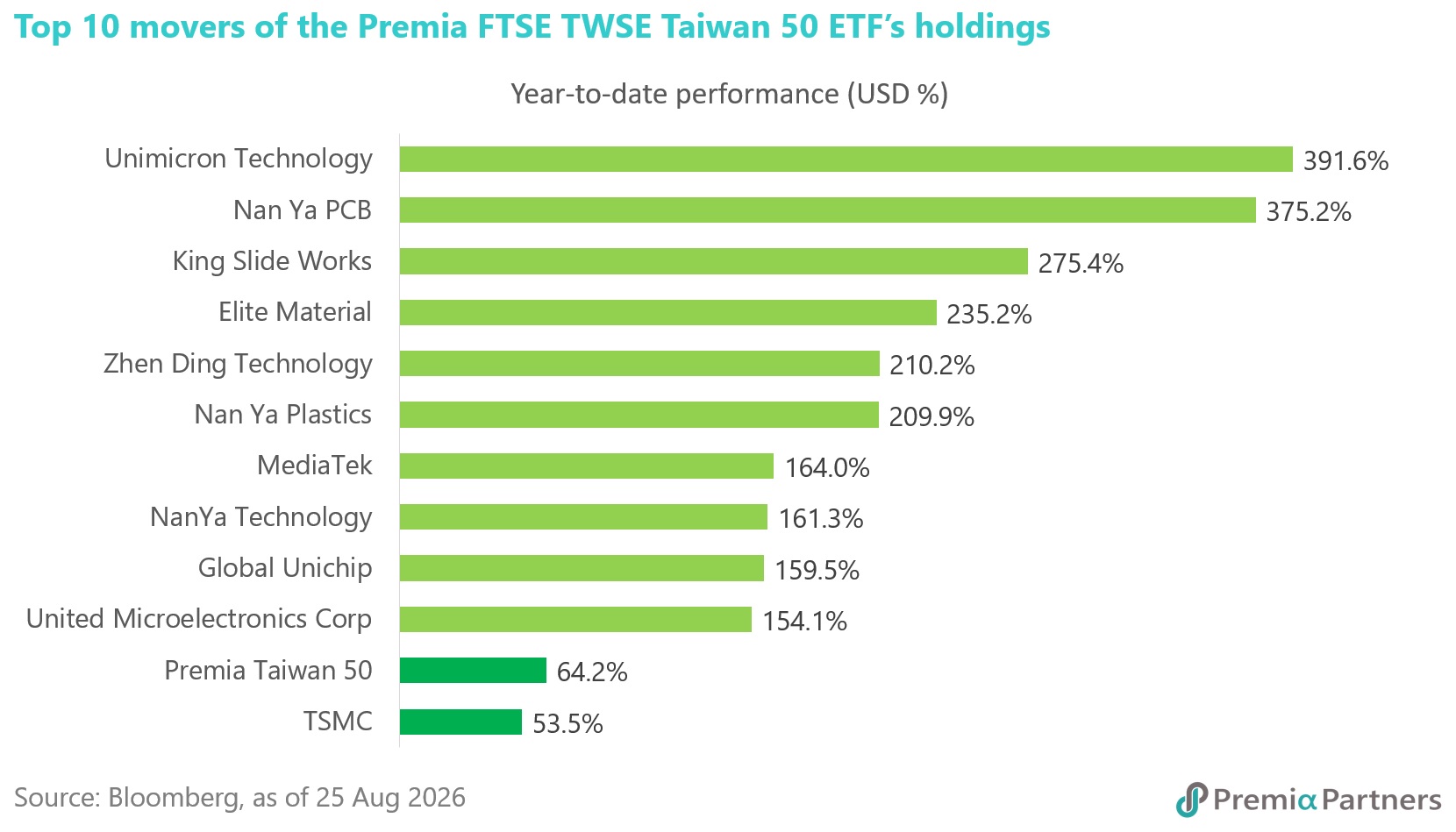
- Advanced packaging and substrates: ASE Technology is one of the global leaders in the outsourced semiconductor assembly and testing (OSAT) space, playing an increasingly important role as semiconductor packaging becomes more sophisticated and the supply demand dynamics hugely favour the most advanced leaders across the value chain. Unimicron Technology and Nan Ya PCB are major suppliers of high-density substrates and printed circuit boards required to connect increasingly powerful processors and memory. Elite Material sits further upstream, supplying high-performance copper-clad laminates that are critical for high-speed, high-frequency PCB applications.
- Power and thermal management: The growth in AI computing also creates another set of bottlenecks: electricity and heat. Delta Electronics is a leading provider of power management and electrical infrastructure, while Asia Vital Components (AVC) specializes in thermal-management solutions, including liquid cooling technologies increasingly required by high-density AI servers. When a hyper-scaler builds an AI factory in Asia, buying a pre-integrated system from Delta eliminates massive engineering headaches, and for the vital Coolant Distribution Unit (CDU) systems used in advanced white space liquid cooling, Delta holds a commanding global market share of over 50%. Meanwhile industry analysts estimate AVC commands 70% market share in cold plates designated for hyperscaler AI servers, and Nvidia has officially named AVC as one of only four standardized preferred suppliers globally for the next-generation Vera Rubin pure-liquid platform.
- Networking and system integration: AI computing increasingly depends on connecting thousands of processors together. Accton Technology is a major supplier of high-speed networking equipment, including next-generation datacenter switches. In the open networking market for hyper-scalers, Accton is estimated to hold a massive 60% to 70% global market share. At the system level, Hon Hai Precision Industry, better known as Foxconn, integrates many of these components into complete server systems for the world’s largest technology companies and hyperscalers. As the largest Apple supplier globally, it also is a natural beneficiary of the replacement cycle for smart phones, laptops and consumer electronics as consumers and enterprises upgrade devices for AI adoption.
The point is not that every Taiwanese company will benefit equally from AI spending. Rather, Taiwan has built an unusually deep ecosystem in which different companies participate at various stages of the AI hardware value chain. That gives investors something that a single-stock investment cannot: breadth across the AI infrastructure cycle.
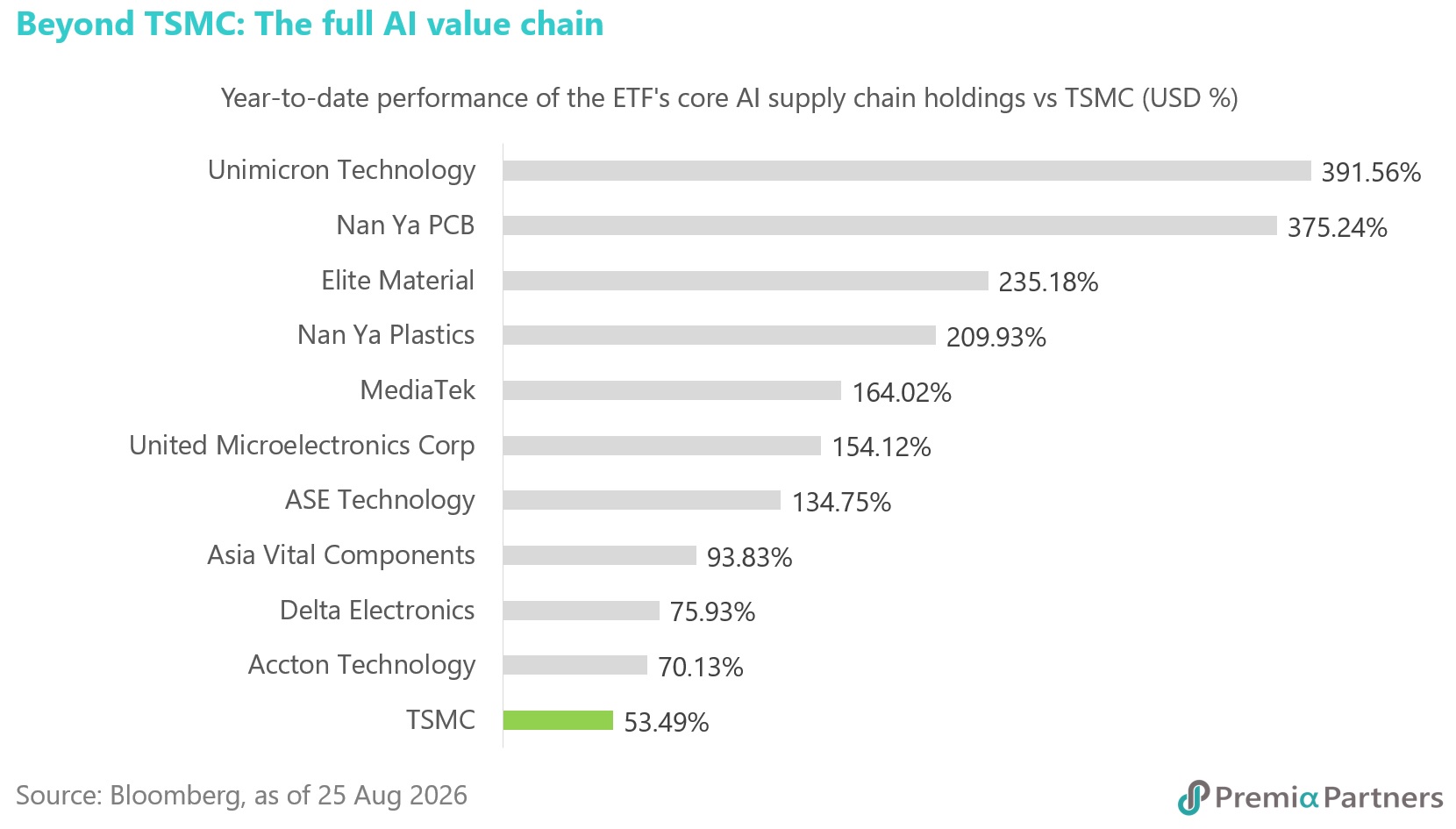
The performance dispersion within Taiwan’s technology universe is telling. While TSMC has delivered a strong return, a number of companies further along the supply chain have performed substantially better this year.
This is consistent with a broader evolution in the AI investment cycle. The first phase was dominated by the companies building the foundational models and the most advanced processors. As AI infrastructure spending continues, the opportunity is increasingly spreading to the “picks and shovels” — the companies supplying the networking, power, cooling, packaging, substrates and systems needed to turn computing capacity into usable AI infrastructure. This is where Taiwan stands out.
A broader way to capture Taiwan’s AI opportunity
For investors, the challenge is therefore not identifying TSMC. It is gaining efficient exposure to the wider offerings without having to select individual winners across dozens of companies.
The Premia FTSE TWSE Taiwan 50 ETF provides exposure to the 50 largest companies listed in Taiwan, retaining meaningful exposure to TSMC while broadening participation across the companies benefitting from AI investment, semiconductor innovation and digital infrastructure expansion.
The ETF’s underlying index also places a 30% cap on TSMC, compared with the significantly higher weight it would otherwise command. This means investors can retain TSMC as the key anchor while allowing greater exposure to the wider technology landscape. This results in the index’s outperformance year-to-date as compared to other benchmarks, including MSCI Taiwan Index, FTSE Taiwan 50 Index and TAIEX.
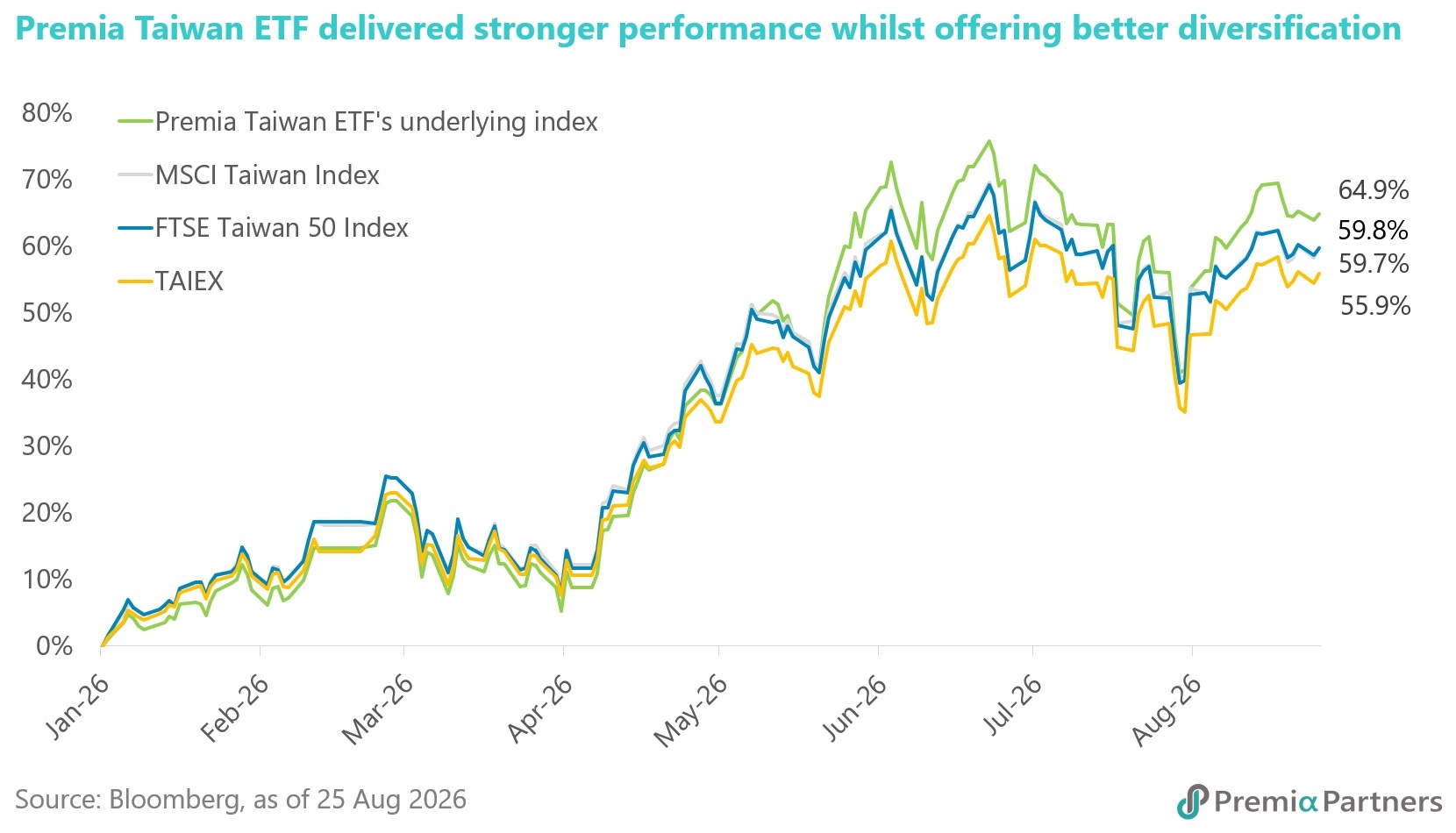
That distinction has become increasingly relevant as the AI investment cycle broadens. The opportunity is no longer confined to the companies designing the most powerful chips. It extends to the manufacturers, assemblers, networking providers, substrate suppliers, power-management specialists and cooling companies that make the entire AI infrastructure stack possible.
For international investors, Taiwan therefore offers a somewhat unusual combination: strong economic and earnings growth, global technology leadership, deep and difficult-to-replicate manufacturing capabilities, and valuations that remain below those of the major US technology indices. Perhaps more importantly, it remains under-owned.