featured insights & webinar

In 2022, our Premia CSI Caixin China Bedrock Economy ETF (“the Bedrock ETF”) outperformed most of the market benchmarks, such as FTSE A50, CSI 300, CSI 500 and ChiNext, by around 10-24% points. In a backdrop of weak equity performance, investors favored low beta and volatility stocks with significant economic value and good financial health, which coincided with the Bedrock ETF’s underlying index methodology and broadly explained why the ETF outperformed in 2022. In this article, we would have a more in-depth look at the portfolio holdings’ companies and decipher drivers of the outperformance and whether this multi-factor approach of low volatility, value, quality and size tilts would continue to power outperformance in 2023.
Feb 03, 2023

Big, long-term trends could drive Developed Market bond yields much higher than the cyclical peaks that the market is currently pricing in. There are cycles and there are secular trends. If the super cycle of rates and yields has turned – off deep negative inflation-adjusted levels – then the lesser cycles could mean- revert a lot higher around long-term uptrends. And we are at this juncture at the moment, as the negative yielding bonds have literally disappeared - the global stock of negative yielding bonds had gone from a peak of US$18.4 trillion late in 2020 to zero recently. What are the true implications behind this abrupt turn of tides? In this article, our Senior Advisor Say Boon Lim discusses the big drivers for potentially much higher rates and yields for this year, and areas we are spending a lot more time monitoring, as the longer-term outlook could be far worse than just a mean reversion in nominal rates and yields as we may also be in the midst of a secular mean reversion in real government bond yields and corporate credit yields.
Jan 17, 2023

If we agree China may offer outperformance in 2023, then the next step is to figure out the right positioning to capture the alphas. Investors are now at a crossroad to decide whether China tech is still investible. On one hand, the Internet platforms, used to be the market leaders, may no longer be the high-growth candidates in future as shown by the recent sluggish financial results. On the other hand, technological advancement remains one of the government’s key agendas that should help support the sector. In this article, we would like to share how to identify the “right” tech exposure to capture the opportunities in China market.
Dec 13, 2022

2023 will likely present investors with a stark economic divergence – between a West in recession and an East where growth will be boosted by recovery in China. ASEAN-5, which already enjoyed its own reopening rebound in 2022, will likely ride the tailwinds of China’s turn at a reopening recovery in the coming year. In this article, we would discuss how ASEAN-5 will likely continue to be in a sweet spot in 2023, offering some of the highest economic growth rates with relatively moderate inflation.
Dec 12, 2022

With the more positive sentiments from the G20 meetings and market expectations of earlier pivot for China’s zero covid policy, growth including technology strategies also started to see varying degree of positive swings and rallies along more sustained upward trajectory. Contrary to the US tech peers, Asia innovative technology and metaverse leaders having started massive corrections earlier also appear to be first in first out and are emerging to resume growth on the back of multiple tailwinds. As investors revisit the investment case for the metaverse and innovative technology space, how would we configure for the opportunities in Asia and fill the gaps that the US oriented global tech strategies typically miss? In this video, we would recap the construct of Premia Asia Innovative Technology & Metaverse Theme ETF (3181/ 9181 HK), which is designed to capture opportunities in Digital transformation, Robotics & Automation, Innovative Green Technology as well as Metaverse which have been transforming the enterprise and consumer space (including with virtual influencers). The strategy was first introduced in 2018, and given the sector and geographic diversification has been outperforming other global, US and China focused peers in 2-year, 3-year and 5-year periods. It was also able to hold at -7% last year after the strong rally of 40% and 60% in 2019 and 2020 outperforming in both bull and bear market cycles. For investors looking for strategic growth opportunities in this space, this would be a good, balanced tool for implementation.
Dec 09, 2022

It was challenging for global investors to find a market that could offer a positive return in 2022. China market can’t escape from the selloff, with H-shares, A-shares and ADRs down by 20% to 29% in dollar return in the first eleven months of the year. The market turnover was shrinking whilst foreign investors were net selling. Internally, the frequent COVID-lockdowns, a property market slump, an ongoing Internet scrutiny, and the deteriorating bilateral relationship between China and the US all contributed to the bearish sentiment in Chinese equities. Externally, the Ukraine-Russia war, high inflationary pressure, an accelerated rate hike cycle, and strengthening dollar have further weakened investors’ confidence towards risky assets.
Dec 06, 2022

In a discordant world, there are no overarching investment themes. The different parts of the world are marching to different drums – their economies and markets are driven by different cycles, different prior policy choices and factors beyond their control. The US economy and market are paying back for the extreme policy stimulus of 2020-2021. Europeans are paying back for the same, with the added pain of a war outside their control. Japan is battling a chronic ailment – extreme debt – made acute by sharply higher cost of US funds. China is at the bottom of its policy cycle, at the beginning of a path out of COVID health controls.
Dec 05, 2022

After finishing Q2 as the only emerging market in positive territory, the effects of zero-COVID policy, a continued slump in the property market, and weakening global demand pushed Chinese stocks to the bottom of the EM index in Q3. The CSI 300 Index dropped by -14.3% over the three months from July to September 2022. Below, we offer deeper insights into third-quarter performance—including some bright spots among state-owned enterprises and technology with a policy tailwind—along with our thinking on October’s National Congress and what the rest of the year might have in store.
Oct 31, 2022

Unlike in developed markets, healthcare is actually a growing “new economy” sector in China that offers tremendous opportunities for global investors. As the Chinese economy evolves, the sector also enjoys fundamental tailwinds such as rising demand for healthcare and wellness services as living standards improve, and an aging population with low birth rates. Meanwhile being a growth sector with public interest concerns that is also popular among retail investors, the healthcare sector also experiences volatility swings and regulation tailwinds from time to time such that taking a diversified approach with consideration for fundamentals may be more optimal. In this article, we would take a closer look at the various underlying sub-segments, review their characteristics and also highlight some of the leading A-share companies driving the growth opportunities in their respective space.
Sep 20, 2022

If the KOLs (key opinion leaders) have stormed the world with livestreaming and short videos globally in recent years, the metaverse is bringing on a new cohort of KOLs across Asia – virtual influencers. In fact, Asia is already seeing very rapid growth of virtual influencers, given the high internet penetration, digital economy and demographic tailwinds across the region. From Korea, China, Japan to Singapore, Malaysia and Thailand, brands and marketers across industries are increasingly ready to adopt and experiment, especially those targeting young consumers. In fact according to Jing Daily estimates, of the 80% of Chinese netizens following online celebrities, over 60% follow virtual idols and over half spending at least RMB500 a month on related purchases. Virtual KOLs also are said to often have interaction rates three times higher than their real counterparts. In this article, we shall share more about this coming of age of virtual influencers in Asia, with a deeper dive into the observations in Korea where the virtual influencers are bringing important new elements to the K-pop industry.
Sep 09, 2022
BY TOPICS
Chart Of the Week

Michael Ng
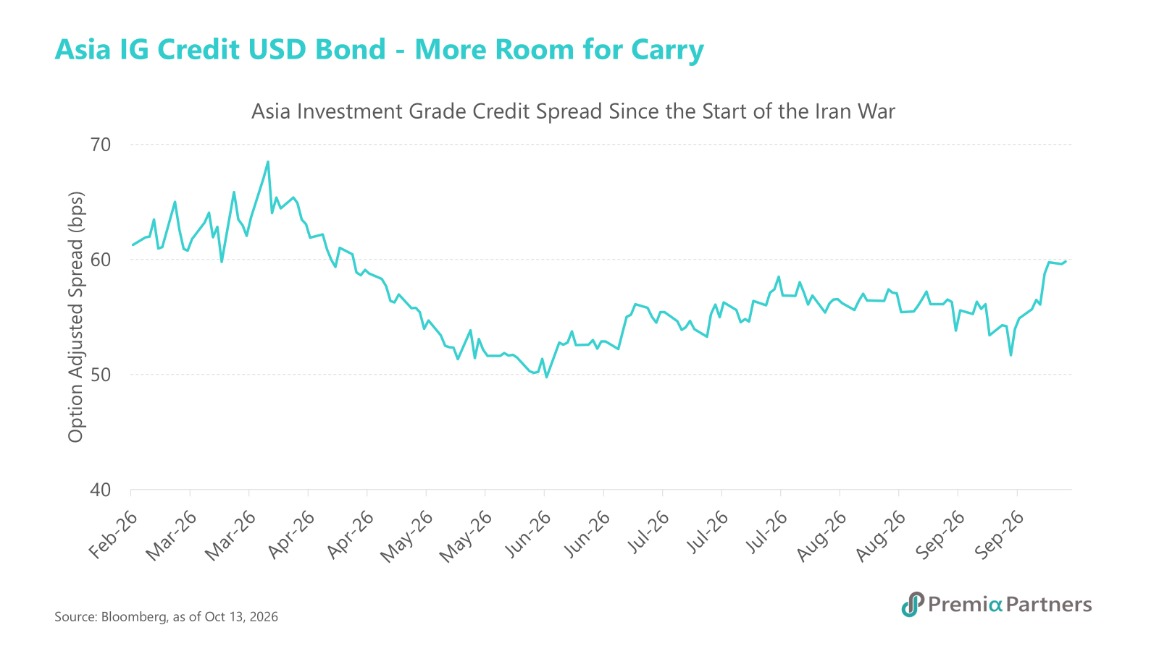
Year-to-date Premia J.P. Morgan Asia Credit Investment Grade USD Bond ETF (Premia Asia IG ETF) has outperformed longer duration peers. Even as US Treasuries yield widened to their highest yields in over two decades, the Asia IG ETF has proven relatively resilient. Across assets classes, some investors now see US Treasuries as better value than US equities and started rotating from US risk asset to duration – yet Asia IG still offers a yield pickup over US Treasury - making it even more attractive. Asian credit spreads widened modestly in recent weeks on concern about Indonesia and Philippines, and have begun to retrace as those worries ease. In our view, the current spread level offers a better window to add to Asia investment grade (IG) credit. Indonesia has been viewed as the region's main fiscal pressure point, with concerns over state spending and the credibility of the 3% of GDP deficit cap weighing on Asian spreads more broadly. The government has since begun to rein in expenditure. While the announced measures look modest, but markets read them as a sign of discipline : Indonesia's 5-year CDS has eased from a recent high of ~96bps to ~91bps as of 12 October, pointing to stabilisation. Meanwhile, despite the near-term pull back in the US 10-year yield, large US deficits point to heavier issuance, so holding long duration outright carries meaningful risk. Shorter-duration IG credit offers a better balance. The Premia J.P. Morgan Asia Credit Investment Grade USD Bond ETF (3411/9411 HK) offers a ~4.3-year duration and a ~5.5% average yield to maturity, with an average A rating and around 10% in floating-rate notes. That lets investors earn carry and stay invested with moderate rate exposure. In a market still arguing over where yields settle, The Premia Asia IG ETF offers a way to be paid while the debate plays out — a better balance between rate bets and carry, and a more sensible place to “keep calm and carry on”.
Oct 14, 2026