featured insights & webinar

The latest developments in the battery industry continue to favour the world’s biggest players. Apart from their gains from the robust growth in EV sales, the latest developments in battery technology also work in their favour, given their significant investments in R&D spending. Over the next five years or so, lithium iron phosphate (LFP) and ternary (NCM) lithium batteries will remain the mainstream products in the mass and high-end segments respectively. These are the products that CATL and BYD lead globally. Beyond that, CATL and BYD are already moving rapidly in the area of solid-state batteries (SSBs), a potentially disruptive technology. In this article, we discuss about why the Chinese battery makers will continue to dominant the global market and benefit from their technological advancements that revolutionize the energy storage landscape.
Nov 15, 2024

The third quarter ended with a bang for mainland Chinese stocks, as twin announcements from China’s central bank and top fiscal policymakers gave both foreign and domestic investors plenty to think about over an extended market holiday during China’s October Golden Week. In this insight, Dr. Phillip Wool, Global Head of Research of Rayliant Global Advisors, explores the shift in sentiment that sent the onshore China markets higher for the quarter, breaking down the economic implications of a renewed and forceful stimulus push, the factor drivers of Q3 equity performance, and the data investors should be looking forward to as 2024 draws to a close.
Nov 15, 2024

Further to the insight piece on “Taiwan: The Quiet World-Beater” shared by our Senior Advisor Say Boon Lim, in this article we share more about our new ETF Premia FTSE TWSE Taiwan 50 ETF, which covers the 50 largest flagship companies in Taiwan by market capitalization. The strategy aims to capture the strong market performance from the robust growth in demand for semiconductors and the broader economic growth activities in Taiwan in the coming years. It is designed as a low-cost, tax efficient access tool, with versatility of having both HKD (distributing) and USD (accumulating) unit classes.
Oct 09, 2024

As the US Fed rate cut gets imminent, the liquid Asia credit market also is set to benefit from a number of strong tailwinds. In addition to favourable macroeconomic fundamentals, the heterogenous region also offers benefits of broad geographic diversification benefits and positive reinforcement from continued market liberalization and more investor friendly reforms. Within this space, Asian investment grade (IG) bonds also enter a favourable “Goldilocks” scenario in particular, represent a sweet spot that international allocators sometimes overlook, offering meaningfully higher yields, better credit ratings, and shorter duration than their peer IG cohorts from the US and Europe.
Sep 16, 2024
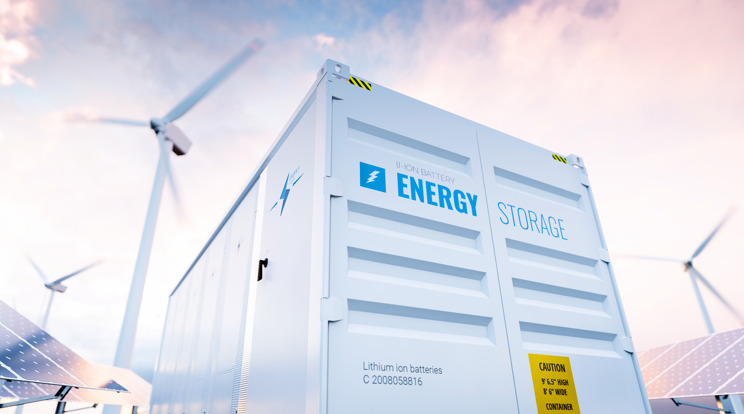
Given the inextricable links between energy-hungry Artificial Intelligence and renewables, energy storage and smart grids are a necessary “final mile solution” in the intensifying AI race. They provide the critical capability to store and dispatch huge quantities of uninterrupted renewable energy/power on demand without compromising emission reduction targets. In this regard, China is uniquely positioned to tackle the related challenges of AI and renewable energy with its rapid development and upgrades of energy storage systems and smart grids. In fact the country has long been studying intertwined strategic relationship between AI, technology and energy, and studiously incorporate such thinking into its Five Year Plans, and which are subsequently being rolled out as China’s East Data West Computing initiative. Further to our recent insight on China’s “power infrastructure” as the critical enabler for AI-development, in this article, we zoom in on China’s capabilities and investment opportunities in energy storage as the linchpin that holds the last mile solution, and matches renewable energy production with industrial demand in China’s journey to a high-tech, modern society.
Sep 11, 2024

In the midst of the AI-driven excitement surrounding major US tech giants, Taiwan has been quietly positioning itself as a significant player in the global technology sector. Over the past two years, Taiwan’s stock market has outperformed all major Asian markets and even surpassed the S&P 500 and Nasdaq 100 in returns. This success can largely be attributed to Taiwan's critical role in the semiconductor industry, which continues to drive its economic growth and investment appeal. In this article, our Senior Advisor Say Boon Lim discusses drivers supporting the unique, strategic moat Taiwan has built over the years, and why it will likely remain an attractive investment destination going forwards, on the expected continued robust growth in demand for semiconductors and its broader economic growth activities over coming years.
Sep 05, 2024

The time has come – Federal Reserve chair Jerome Powell finally signalled that rate cuts will likely start in Sep at Jackson Hole, though his remarks offered few clues as to how the Fed might proceed after its Sep gathering. On the surface, extending duration in US Treasuries appears to be a straightforward decision given the assumption that falling interest rates will lead to rising bond prices. However, it is not without risks and complexity as we are entering the rate cut cycle against very different backdrop from previous cycles. In this article, we discuss the intricacies of the upcoming rate cut trajectory, and why US Treasury Floating Rate Notes (FRNs) remains a relevant strategy for investors seeking diversification and stability as a result of the very much inverted yield curve, and market uncertainties in this journey.
Aug 28, 2024

Going into a July meeting of top party officials at China’s Third Plenum, held once every five years, first-quarter hopes of a 2024 recovery in China’s economy had given way to macro uncertainty, as strength in manufacturing and exports served for many to highlight just how weak domestic sentiment and consumption remain. In this article, Dr. Phillip Wool, Global Head of Research of Rayliant Global Advisors, digs into such challenges and potential paths forward for Beijing, including our thoughts on a Third Plenum meeting that didn’t yield any policy bombshells, but still offers clues as to where investors might focus as we enter the second half ready for bargain hunting.
Jul 30, 2024

While Artificial Intelligence Generated Content (AIGC) has been dominating media and market attention, the “next big thing” has been developing rapidly in the background in China, in the form of super-scale AI infrastructure. It involves, among other things, a national computing power network; data centre clusters from Guangdong to Inner Mongolia and from Gansu in the West to Anhui in the East; centres for the development/training of large language models; and abundant green energy integrated with massive energy storage facilities. What is rapidly emerging is a gigantic national network connecting smart grids, intelligent network routing and energy storage – one that has no parallel anywhere else in the world. The pay off will be lower cost execution of computing processes and high-end manufacturing/AI-based industrial automation. The current media focus has been on the speed of the microchip as the key factor in the AI race. The following insight details the elements of the AI-infrastructure that are likely to prove critical in the next phase of AI development.
Jun 19, 2024

China’s household consumption appears to have been massively underestimated in international comparisons, because of differences in data definitions and valuation methodologies. The two big areas of differences in international comparisons are: 1) Social transfers in kind, which could be worth some 6% of GDP; and 2) The value of housing services provided by owner-occupied homes, which could be worth another 5% of GDP. In this article, our Senior Advisor Say Boon Lim discusses why the criticisms of China’s growth model and "underconsumption" look flawed.
May 09, 2024
BY TOPICS
Chart Of the Week

Michael Ng
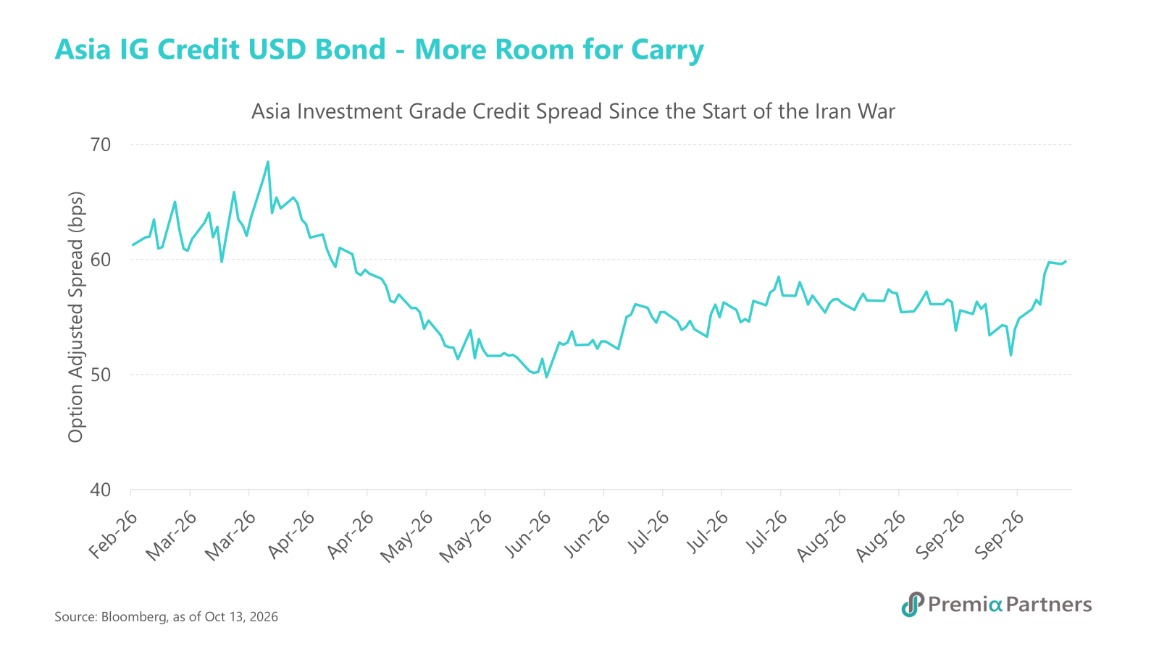
Year-to-date Premia J.P. Morgan Asia Credit Investment Grade USD Bond ETF (Premia Asia IG ETF) has outperformed longer duration peers. Even as US Treasuries yield widened to their highest yields in over two decades, the Asia IG ETF has proven relatively resilient. Across assets classes, some investors now see US Treasuries as better value than US equities and started rotating from US risk asset to duration – yet Asia IG still offers a yield pickup over US Treasury - making it even more attractive. Asian credit spreads widened modestly in recent weeks on concern about Indonesia and Philippines, and have begun to retrace as those worries ease. In our view, the current spread level offers a better window to add to Asia investment grade (IG) credit. Indonesia has been viewed as the region's main fiscal pressure point, with concerns over state spending and the credibility of the 3% of GDP deficit cap weighing on Asian spreads more broadly. The government has since begun to rein in expenditure. While the announced measures look modest, but markets read them as a sign of discipline : Indonesia's 5-year CDS has eased from a recent high of ~96bps to ~91bps as of 12 October, pointing to stabilisation. Meanwhile, despite the near-term pull back in the US 10-year yield, large US deficits point to heavier issuance, so holding long duration outright carries meaningful risk. Shorter-duration IG credit offers a better balance. The Premia J.P. Morgan Asia Credit Investment Grade USD Bond ETF (3411/9411 HK) offers a ~4.3-year duration and a ~5.5% average yield to maturity, with an average A rating and around 10% in floating-rate notes. That lets investors earn carry and stay invested with moderate rate exposure. In a market still arguing over where yields settle, The Premia Asia IG ETF offers a way to be paid while the debate plays out — a better balance between rate bets and carry, and a more sensible place to “keep calm and carry on”.
Oct 14, 2026