featured insights & webinar

Although the US Dollar Index DXY is likely to pick up a bit more in coming weeks if equities weaken, the longer-term outlook for the Greenback beyond the acute phase of COVID-19 is bleak.
Jun 23, 2020
In crisis times like the current COVID scenario, when many stocks are at multi-year lows and finding opportunities seems to be challenging, our Premia Asia Innovative Technology strategy has proved to be among the most resilient large-cap thematic strategies that has rebounded well above the pre-COVID level with a YTD return of 7.1% (as of 6/12/2020) while also recently hitting an impressive record-high since its inception in August 2018. In this piece, we decipher for you this strategy’s exposures and why it is (more) relevant to investors, particularly post-COVID.
Jun 18, 2020
As cyclical movements would revert and short-term volatility hikes would calm, long-term strategic investors often look out for overarching secular or structural trends. Yet by definition, structural shifts and new innovations often take time. However, there can be catalysts! Witnessing a black swan can be a crisis, but like Winston Churchill advised – let’s not waste a crisis. So where do we look for growth opportunities?
Jun 12, 2020

The Two Sessions are always of interest to the market for the key economic policies unveiled by Chinese leaders. At this year’s Two Sessions, China decided not to set a GDP growth target for the first time in decades, raised the budget deficit ratio above a long-held “red line,” issued special treasury bonds for the first time in the last 2 decades, and rolled out a host of measures to buoy employment and support economic recovery from Covid-19.
Jun 10, 2020
IoT, or Internet of Things, has gradually become well-known to all as applications such as connected cars and smart home appliances gain popularity in the consumer space. As we have been advocating, enterprise digitalisation would be a game changing space to watch – and IIoT is one of the critical piece of it. In fact, IIoT is among the #NewInfrastructure agenda that was specifically mentioned as policy support priority in China. So what is IIoT? And why are the leaders resilient through and beyond COVID? In this piece, we will share the concept of IIoT (Industrial Internet of Things), the industry revolution in this space, and the implications to investors.
May 26, 2020
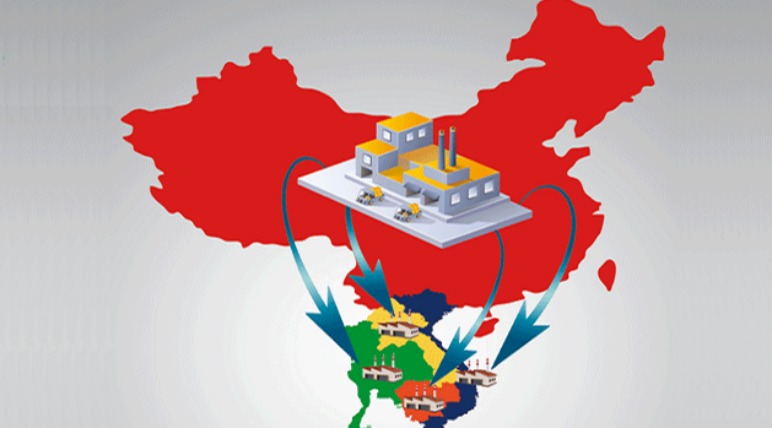
Given the trade tensions and looming risks of de-globalisation, it is likely that China will embark on a different growth path in the aftermath of COVID, and increasingly rely on domestic demand to drive growth. This structural shift holds significant implications for EM Asia. In fact, ASEAN replaced the European Union as China’s biggest trading partner in 1Q20. In this webinar, our co-CIO David Lai shares our research and insights on investing into ASEAN markets in light of the late COVID crisis, re-escalating US-China trade dispute and more importantly the gradual global supply chain reconfiguration.
May 26, 2020

China is in the early stage of restarting its economy, and China A shares market has held up relatively well compared to other global equities markets amid the COVID. In particular, our Premia China New Economy strategy has been very resilient throughout the crisis with YTD NAV performance of 10.7% (in CNY, as of May 26th, 2020). It has been consistently seeing inflows over the past months and is also among the best performing broad market China A ETFs globally. In this webinar, our co-CIO David Lai shares first-hand insights on the post-COVID impact, policy developments, and capital market flows of the Chinese market. As China recovers from the pandemic, how shall investors watch out for opportunities from the post-COVID recoveries, policy supports and new norms?
May 26, 2020
Vietnam government has started a gradual and orderly reopening since April 23rd, though the macro data was still weak as expected due to the lockdown around the world. After initially keeping the goal for 5% GDP growth this year the government revised growth target last week to a two-scenario range of 4.4%-5.2% if major trading partners can control the outbreak by end of Q3 and 3.6%-4.4% if by Q4. How are things doing in Vietnam at the moment? Is it the time to position for recovery? Here is a quick update on the various.
May 18, 2020
Given the trade tensions and looming risks of de-globalisation, it is likely that China will embark on a different growth path in the aftermath of COVID, and increasingly rely on domestic demand to drive growth. This structural shift holds significant implications for EM Asia. In fact, ASEAN replaced the European Union as China’s biggest trading partner in 1Q20. And as a result of the increased tension and US protectionist measures targeting China, and pressure for MNCs to choose which one they side with under the pretext of protection against production disruptions in China, ASEAN and notably Vietnam are clear winners. But a more nuanced picture is closer to the truth. That is, the shifts in supply chains are more likely to be gradual than dramatic.
May 18, 2020
Yes, possibly. The different approaches taken by the US and China towards managing COVID-19 has likely set the stage for a widening of the growth differential between the two countries. Immediately, the earlier reopening of the Chinese economy means China’s GDP will still show a bit of growth this year. This compares to the controversial, tentative easing of restrictions in the US, only in May. Even if the US gradually normalizes from here, its GDP for will end 2020 with a big hole, which will take three to four years to fill. If China maintains its productivity growth, it should be able to manage a long-term average GDP growth rate of around 5.8% a year. Meanwhile, long-term US GDP growth from 2022 onwards could ease to 1.5% on lower investment/lower productivity growth. Taking into account IMF projected growth rates for 2020 and 2021, China could overtake the US in Dollar terms by 2029.
May 13, 2020
BY TOPICS
Chart Of the Week

Michael Ng
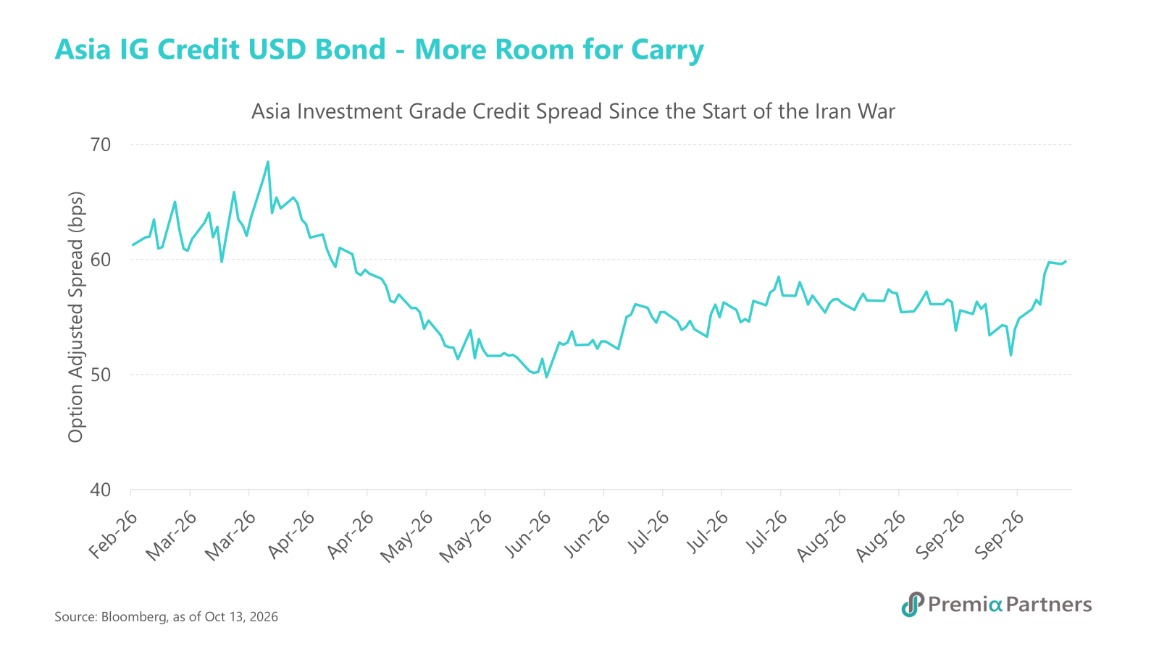
Year-to-date Premia J.P. Morgan Asia Credit Investment Grade USD Bond ETF (Premia Asia IG ETF) has outperformed longer duration peers. Even as US Treasuries yield widened to their highest yields in over two decades, the Asia IG ETF has proven relatively resilient. Across assets classes, some investors now see US Treasuries as better value than US equities and started rotating from US risk asset to duration – yet Asia IG still offers a yield pickup over US Treasury - making it even more attractive. Asian credit spreads widened modestly in recent weeks on concern about Indonesia and Philippines, and have begun to retrace as those worries ease. In our view, the current spread level offers a better window to add to Asia investment grade (IG) credit. Indonesia has been viewed as the region's main fiscal pressure point, with concerns over state spending and the credibility of the 3% of GDP deficit cap weighing on Asian spreads more broadly. The government has since begun to rein in expenditure. While the announced measures look modest, but markets read them as a sign of discipline : Indonesia's 5-year CDS has eased from a recent high of ~96bps to ~91bps as of 12 October, pointing to stabilisation. Meanwhile, despite the near-term pull back in the US 10-year yield, large US deficits point to heavier issuance, so holding long duration outright carries meaningful risk. Shorter-duration IG credit offers a better balance. The Premia J.P. Morgan Asia Credit Investment Grade USD Bond ETF (3411/9411 HK) offers a ~4.3-year duration and a ~5.5% average yield to maturity, with an average A rating and around 10% in floating-rate notes. That lets investors earn carry and stay invested with moderate rate exposure. In a market still arguing over where yields settle, The Premia Asia IG ETF offers a way to be paid while the debate plays out — a better balance between rate bets and carry, and a more sensible place to “keep calm and carry on”.
Oct 14, 2026